Why Your Gas Fireplace Pilot Light Won't Stay Lit
You turn the knob, hold it down, the little blue flame appears — and the second you let go, it's gone. Or it stays lit for a few minutes, then quietly gives up. In Post Falls, this is the single most common fireplace call we get every October, and it's almost always the same handful of causes. Here's what's actually happening, what you can safely check yourself, and where the line is.
You turn the knob, hold it down, the little blue flame appears — and the second you let go, it's gone. Or it stays lit for a few minutes, then quietly gives up. In Post Falls, this is the single most common fireplace call we get every October, and it's almost always the same handful of causes. Here's what's actually happening, what you can safely check yourself, and where the line is.
What the pilot light does
Your gas fireplace's pilot is a tiny flame whose job is to stay burning whenever the fireplace might be used. More importantly, it heats a small copper sensor called a thermocouple (or in many units, a thermopile). That sensor generates a small electric signal that tells the gas valve "it's safe to stay open." If the sensor cools down — or never heats up — the valve shuts the gas off. That's a safety feature, not a defect. The system is working exactly as designed; the problem is whatever is keeping the sensor from getting hot enough.
The usual suspects, in order
1. A dirty pilot assembly. Over the summer, dust settles in the pilot tubing and spider webs collect in the tiny pilot orifice. When you fire up the fireplace for the first time in fall, the pilot flame is weak, lazy, or yellow — and it's not aimed squarely at the thermocouple. The sensor never gets hot enough to hold the valve open. This is the classic "worked fine in April, won't stay lit in October" story.
2. A worn-out thermocouple. Thermocouples degrade with heat cycles over time. A weak one produces a marginal signal — enough to hold the valve while you're manually holding the knob down (the pilot override), but not enough to keep it open on its own once you release. If cleaning the pilot doesn't fix it, a tired thermocouple is the next most likely answer.
3. A weak thermopile. Many gas fireplaces use a thermopile — essentially a stack of thermocouples that generates enough power (usually 500+ millivolts) to run the whole system, including the main burner. A thermopile that's losing strength may still light the pilot fine but produce erratic readings. When the main burner demand comes in, voltage sags and everything shuts down.
4. Gas supply problems. If the gas supply to the fireplace is restricted — a partially closed shutoff valve, a kinked flexible line behind the unit, or low supply pressure — the pilot starves. This is less common but worth checking, because the shutoff valve for your fireplace is often located in a basement, crawlspace, or floor box that someone may have touched during summer projects.
5. A downdraft blowing the pilot out. If your pilot lights, stays lit for a while, then goes out on windy days, cold air may be coming down the vent and physically blowing the flame off the sensor. This is a venting or draft issue, not a part failure.
What you can safely check yourself
Before calling anyone, run through this list. None of these involve tools or touching gas connections:
- Confirm the gas is on. Find the fireplace's shutoff valve (often a small lever or key valve near the unit, in a floor box, or in the basement below) and make sure it's fully open.
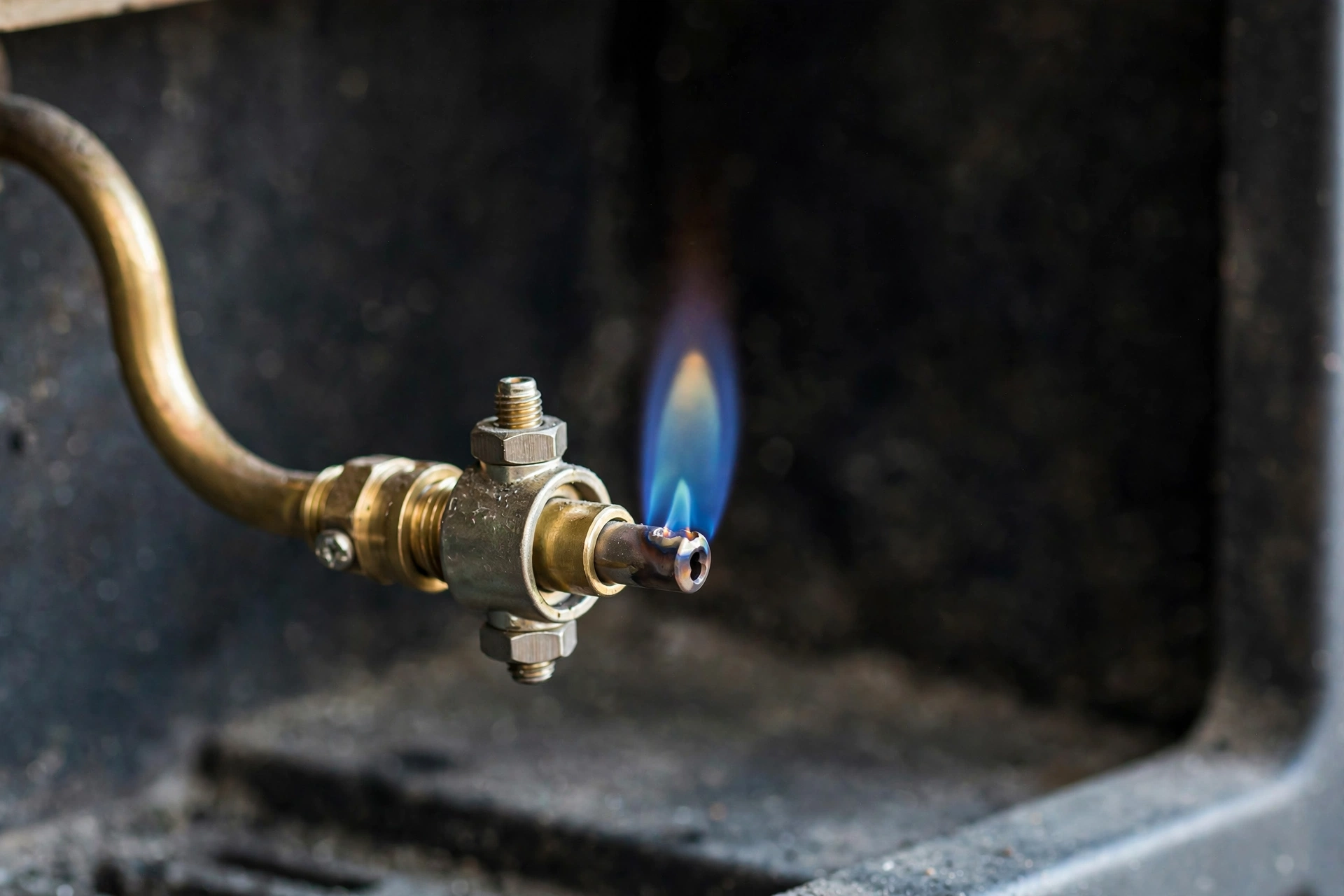
- Look at the pilot flame. It should be a strong, mostly blue flame that firmly wraps around the tip of the thermocouple or thermopile. If it's weak, wavering, or mostly yellow, the orifice is likely clogged.
- Try a careful dust-off. With the fireplace cool and the pilot off, you can gently blow out visible dust around the pilot assembly with a can of compressed air or a soft brush. Don't poke the orifice with pins or wire — the hole is precision-sized, and enlarging it creates a bigger problem.
- Check the glass. On direct-vent units, a loose or unsealed glass front changes the combustion air balance and can cause pilot instability. Make sure the glass is seated and latched the way it should be.
- Clear the area. Combustion air vents around the unit shouldn't be blocked by furniture, blankets, or boxes stored over the summer.
When cleaning isn't enough
If the pilot flame looks healthy and blue but still won't stay lit after a gentle cleaning, the thermocouple or thermopile has almost certainly reached the end of its life. Replacing one is a standard service call: the part itself is inexpensive, and a technician can test the sensor's output with a multimeter to confirm before swapping it. That's actually an important detail — a good tech measures first and replaces second, rather than throwing parts at the problem.
Downdraft issues are the other "needs a pro" category. Fixing wind-related pilot blowout usually means inspecting the vent termination outside — a missing or damaged vent cap, a termination in a wind-exposed spot, or a vent that has settled out of spec — and correcting it. That's roof and vent work, not a living-room job.
Why October is peak season for this
Pilot assemblies hate long idle periods. Six months of summer means dust, spider webs, corrosion on electrical connections, and weakened thermopiles that were barely hanging on last spring. The first firing of the season is a stress test, and marginal parts fail it. If your fireplace is hard to start this fall, you're not unlucky — you're right on schedule. It's also the argument for a fall fireplace tune-up before the first cold snap, when the pilot can be cleaned and the sensor tested while a service visit is still easy to book.
When to call FireFix
Call us when the pilot won't stay lit after a basic cleaning, when the flame looks fine but the valve won't hold, when the pilot goes out repeatedly on windy days, or when the problem comes back every season. Pilot issues are one of our most common calls, and most are resolved in a single visit. Reach us at +1 (208) 668-8111.
Fireplace trouble? Call FireFix.
Fireplace repair, inspection, and maintenance across Post Falls, Idaho — diagnosed properly, explained plainly, fixed right.