Gas Fireplace Won't Turn On? A Checklist, in Order
The pilot is lit — or maybe it isn't — but either way, nothing happens when you flip the wall switch or hit the remote. Before you assume the worst (a dead gas valve is the fear most homeowners have), work through this checklist in order. About two-thirds of "my fireplace won't turn on" calls turn out to be something simple. The fixes get more technical as you go down, and the list tells you where to stop.
The pilot is lit — or maybe it isn't — but either way, nothing happens when you flip the wall switch or hit the remote. Before you assume the worst (a dead gas valve is the fear most homeowners have), work through this checklist in order. About two-thirds of "my fireplace won't turn on" calls turn out to be something simple. The fixes get more technical as you go down, and the list tells you where to stop.
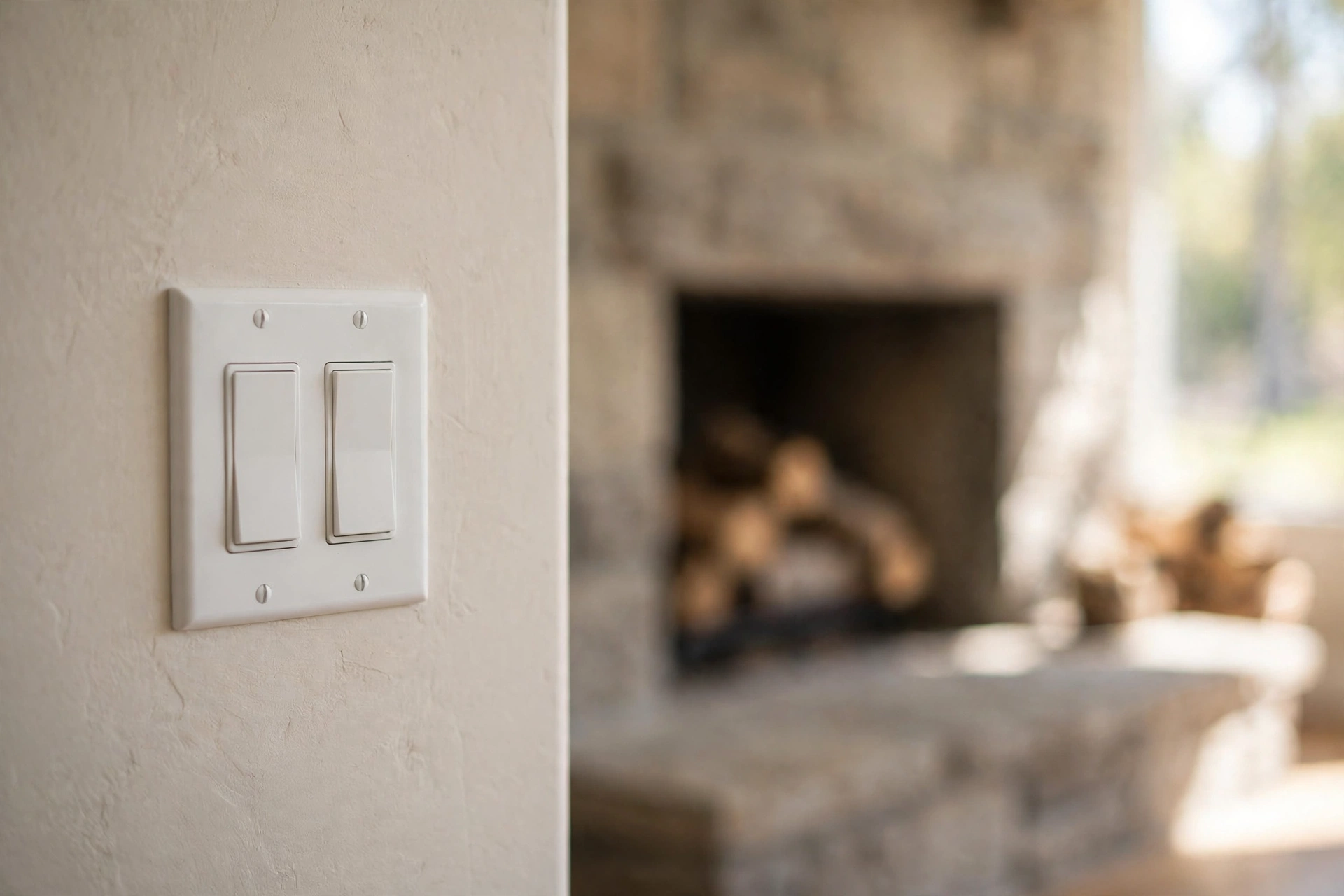
Step 1: The wall switch
Gas fireplaces in Post Falls homes — especially the direct-vent units common in North Prairie and Post Falls East builds — are usually controlled by a simple wall switch that looks exactly like a light switch. It's the number-one overlooked cause.
- Flip it a few times. These switches carry low voltage and their contacts corrode over a summer of disuse.
- If flipping does nothing, the switch itself may have failed. They're inexpensive and fail regularly.
- Some homes have the switch in a non-obvious spot — behind a door, in a hallway, low on a side wall. Make sure you're flipping the right one and that it's actually in the "on" position.
If you have a remote instead of (or in addition to) a wall switch, skip to Step 3 after checking the switch.
Step 2: The breaker and any power supply
Many gas fireplaces with electronic ignition, blowers, or control modules need household power. Some also have a backup battery pack for the ignition.
- Check your breaker panel for a tripped breaker on the fireplace circuit. Reset it once. If it trips again immediately, stop and call — that's an electrical fault, not a fireplace problem.
- If your fireplace has electronic ignition, look for the battery backup pack (usually under the unit or behind the lower access panel). Dead AA or 9V batteries after a summer of sitting are a classic October failure. Replace them with fresh ones.
- If a blower or fan is part of the system, confirm the fan switch or rheostat is on — some fireplaces won't fire the main burner if the blower circuit is dead, depending on the model.
Step 3: The remote
Remotes are the second most overlooked cause, and the most embarrassing service call in the business — a technician drives out and replaces two AAA batteries.
- Replace the batteries in both the handheld remote and the receiver box (the receiver is usually inside or under the fireplace and has its own batteries). Both sides need to work.
- Check that the receiver's slide switch is set to "remote" and not "off." It gets bumped during cleaning more often than anyone admits.
- Re-pair the remote if your model requires it — the manual for your fireplace will have the sequence. If you've lost the manual, the model number is usually on a rating plate inside the lower access panel.
Step 4: The gas supply
No gas, no fire. This sounds obvious, but the shutoff for a gas fireplace is rarely right next to the unit.
- Locate the fireplace's gas shutoff valve. Common spots: a small lever in a floor box beside the hearth, a key valve in the wall, or a valve in the basement or crawlspace directly below the fireplace.
- Make sure it's fully open. If anyone did summer remodeling, plumbing, or furnace work, it may have been closed and forgotten.
- If you have a propane tank rather than natural gas, check the tank level. A fireplace that "suddenly stopped working" in January sometimes just means the tank ran dry.
Step 5: The pilot
If your fireplace has a standing pilot (many older and mid-age units do), the pilot must be lit and healthy before the main burner will fire. If the pilot is out, relight it following the instructions printed on the unit — usually: turn to "pilot," press and hold, light, keep holding for 30–60 seconds, release, turn to "on."
If the pilot won't stay lit, you've got a pilot problem rather than a "won't turn on" problem — weak thermocouple, clogged orifice, or downdraft. That's its own topic, and we cover it in detail in our pilot light troubleshooting guide.
If your fireplace has electronic ignition instead of a standing pilot, there's no pilot to light — the ignition sequence is automatic. If you hear clicking but get no flame, or hear nothing at all, the ignition module, igniter, or control board is suspect. That's technician territory.
Step 6: The thermopile and gas valve
Here's where the simple checks end and diagnosis begins.
- Pilot is lit and strong, switch is on, still nothing? The thermopile may be generating enough power to keep the pilot valve open but not enough to open the main burner valve. Thermopiles weaken with age, and this exact symptom — pilot fine, burner dead — is the signature. A technician tests thermopile output in millivolts and replaces it if it's below spec.
- Everything above checks out? The gas valve itself can fail. Valves do wear out, especially on units 15+ years old. A failed valve is a real repair, but it's diagnosed by testing everything upstream first — a competent tech rules out the thermopile, switch, wiring, and gas supply before condemning the valve.
A note on what "not turning on" tells you
The symptom narrows the search. No click, no pilot, nothing at all usually means power, switch, remote, or gas supply. Pilot lit but no burner usually means thermopile or valve. Clicking with no ignition usually means ignition module or gas flow. Paying attention to exactly what happens (or doesn't) when you try to start it gives the technician a head start — mention it when you call.
When to call FireFix
If you've worked through the switch, breaker, batteries, remote, gas valve, and pilot and the fireplace still won't start — or if anything in the list above made you uncomfortable — it's time for a service visit. Most no-start calls are diagnosed and fixed in one trip: we test the thermopile, check the valve, inspect the wiring, and confirm the venting. Call +1 (208) 668-8111, and tell us exactly what happens when you try to start it — that detail helps us bring the right parts. For anything pilot-specific, our gas fireplace repair page covers what's included in a service visit.
Fireplace trouble? Call FireFix.
Fireplace repair, inspection, and maintenance across Post Falls, Idaho — diagnosed properly, explained plainly, fixed right.